|
|
|
|
|
Submit email feedback on this item:
|
|
|
|
Filename :
|
sp143.jpg |
|
Description :
|
Malibu’s Adamson House is surely the grandest showcase of decorative ceramic tile found in any Spanish Revival home of the Twenties. The sprawling “beach cottage”, as the blueprints modestly describe it, is the work of prominent Los Angeles architect Stiles O. Clements. The Maryland-born Clements received his degree from Philadelphia’s Drexel Institute in 1902, and went on to do postgraduate work at the Massachusetts Insititute of Technology. In 1911 he moved to California, and a year later joined the Los Angeles firm then known as Morgan, Walls, and Morgan; he became a full partner in 1920. By the time he retired in 1960, Clements had designed literally hundreds of major Los Angeles works, including sixty-nine buildings along Wilshire Boulevard alone.
Merritt Adamson and Rhoda Rindge Adamson founded the Adohr Stock Farms dairy in 1916. Adohr (the name Rhoda spelled backwards) was soon ranked among the most technically advanced dairies in the country, and the Adamsons prospered. In the mid-Twenties, the couple engaged Clements to design their new beach house, to be built on a spectacular strip of Malibu beachfront property given to them by Rhoda’s mother, May Knight Rindge.
The elder Rindge can also be credited with the prolific ceramic tile decoration found throughout the Adamson House. In 1926, May Knight Rindge decided to take advantage of the excellent red and buff clays of the area and founded the Malibu Potteries, perhaps the only industry ever located in this exclusive beachfront community. For the next six years, some of the finest decorative tile of the Spanish Revival era would emerge from the pottery’s improbable beachfront factory less than a mile from where the Adamson house now stands. Alas, a disastrous fire in November 1931, coupled with the moribund Depression economy, forced the pottery to close in January of the following year. Despite its brief existence, the products of the Malibu Potteries remain highly prized for their unmatched artistry and brilliance, and today the term “Malibu tile” is all but synonymous with Spanish Revival tilework.
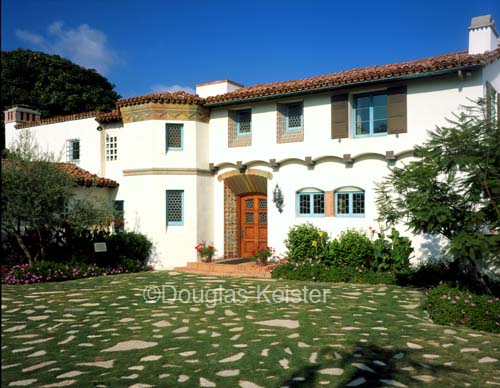
Seen here is the home’s spacious entrance court, with its lawn interspersed with random flagstone paving. The deeply-recessed front entrance sets the tone for the lavish use of tile throughout the rest of the structure. Note also the cast-stone cornice of the stair tower, with its segments tinted in subtle shades suggesting weathered stone, and the Bavarian bottle-glass panes visible in the front door and a number of the windows.
|
|
Keywords :
|
4X5's,sp143.jpg,4X5,Spanish Style,Spanish,Style,Exterior,SpanishGallery |
|